Que vous utilisiez déjà Cloudbeds ou que vous compariez pour la première fois des systèmes de gestion hôtelière (PMS), ce guide vous présente les meilleures alternatives à Cloudbeds à envisager en 2026 pour votre hôtel.
Cloudbeds est une plateforme hôtelière tout-en-un très populaire, utilisée dans plus de 150 pays, qui couvre les réservations, la distribution ARI (disponibilité, tarifs et inventaire), les paiements et les réservations directes. Sa prise en charge des principaux flux de travail de la réception et ses plus de 400 intégrations en font un choix initial courant pour les hôtels indépendants qui évaluent les systèmes basés sur le cloud.
Bien qu’elle offre un large éventail de fonctionnalités, vous souhaiterez peut-être comparer Cloudbeds à d’autres plateformes afin de déterminer si elle offre le niveau de contrôle opérationnel et d’automatisation dont votre équipe hôtelière a besoin de la part d’un PMS. Les motifs d’évaluation courants pour les hôtels incluent :
- Réduire les mises à jour manuelles sur les extranets des OTA
- Accéder à des rapports avancés et personnalisables
- Bénéficier d’un contrôle plus strict sur les règles de tarification, les restrictions et les structures tarifaires
- Consolider les outils de communication au sein d’un seul système
- Améliorer l’automatisation des paiements
- Prévisibilité des coûts globaux du système
Ce guide compare les meilleurs concurrents de Cloudbeds sur les flux de travail PMS les plus critiques pour les hôtels, en utilisant un cadre axé sur les opérations. Plutôt que de nous fier aux arguments marketing, nous évaluons chaque plateforme en fonction de critères clés : profondeur de la synchronisation avec les OTA, capacités de reporting financier, contrôles des revenus et des tarifs, fonctionnalités d’automatisation et d’IA, architecture d’intégration, avis d’utilisateurs réels et transparence des tarifs. Ce cadre permet d’identifier les alternatives qui vous offrent le contrôle centralisé le plus solide en matière de distribution, de reporting, de tarification et de paiements.
Que vous gériez un hôtel indépendant, une chambre d’hôtes, une auberge avec chambres ou un groupe en pleine expansion comptant plusieurs établissements, les sections ci-dessous présentent les alternatives à Cloudbeds qui pourraient le mieux correspondre à votre modèle économique, à la complexité de vos opérations et à votre stratégie de croissance.
Les meilleures alternatives à Cloudbeds en un coup d’œil
- eviivo – Idéal pour les hôtels indépendants grâce à des rapports avancés et une automatisation poussée des OTA dans un PMS tout-en-un
- Mews – Pour les groupes hôteliers qui souhaitent créer une pile technologique personnalisée via des intégrations de marketplace
- Amenitiz – Pour les hôtels à la recherche d’un gestionnaire de canaux pour une distribution ARI de base
- Little Hotelier – Pour les établissements souhaitant une large distribution sur les OTA
- roommaster – Pour les rapports intégrés et la connexion à ampliphi RMS
- RoomRaccoon – Pour une configuration flexible de l’inventaire des services annexes
- ResNexus – Pour le merchandising du moteur de réservation et la mise sur liste noire des clients
1. eviivo – Idéal pour les hôtels indépendants grâce à des rapports avancés et une automatisation poussée des OTA dans un PMS tout-en-un
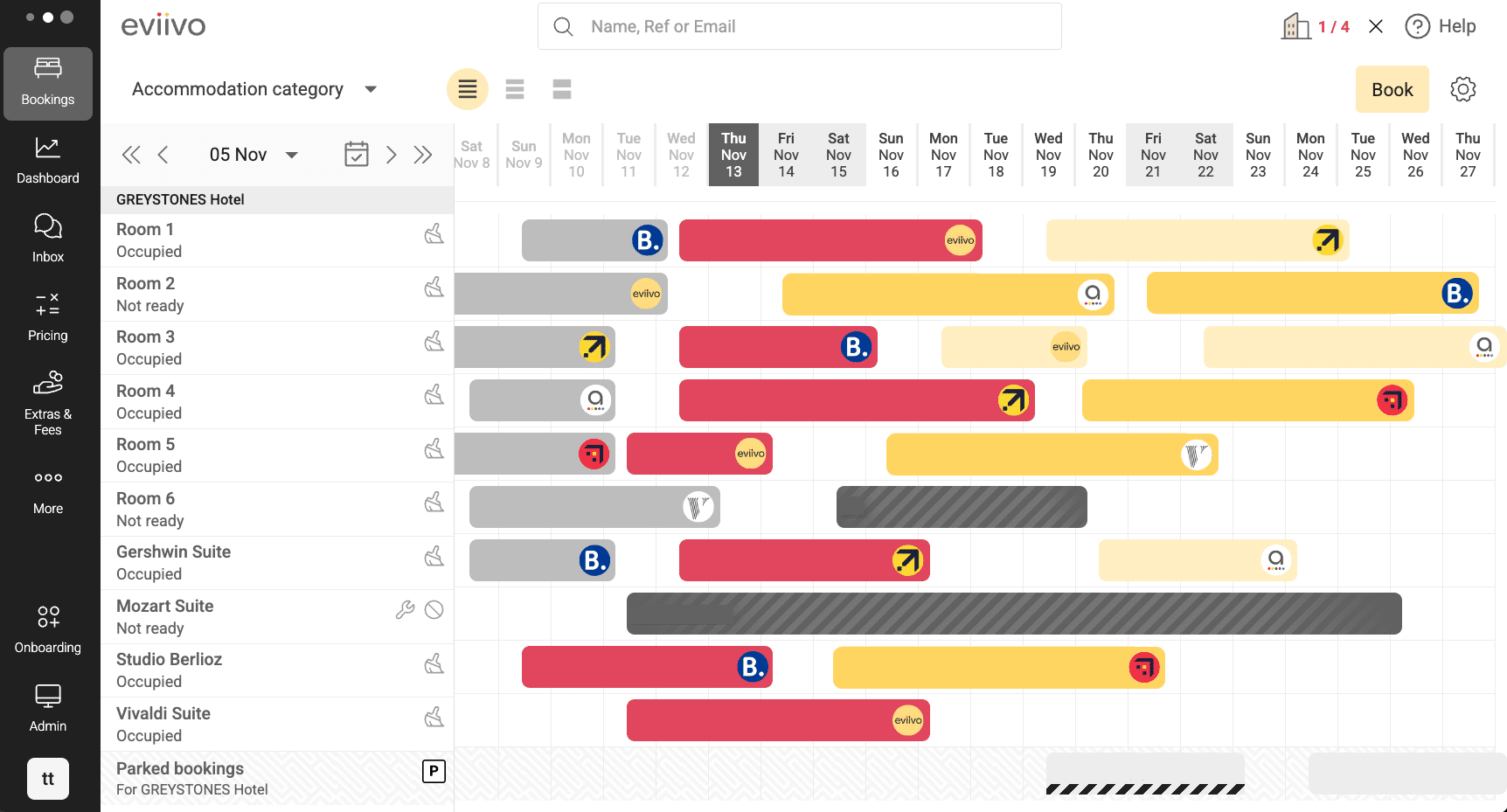
eviivo est un système de gestion hôtelière (PMS) tout-en-un basé sur le cloud, utilisé par plus de 28 000 hôtels, chambres d’hôtes, locations de vacances et réseaux d’établissements à travers le monde. eviivo aide les hôtels indépendants à simplifier leurs opérations en regroupant la gestion des réservations, la distribution sur les canaux de vente, le site web direct, le moteur de réservation, les paiements, le reporting, le housekeeping et la communication unifiée avec les clients au sein d’une plateforme unique et conviviale.
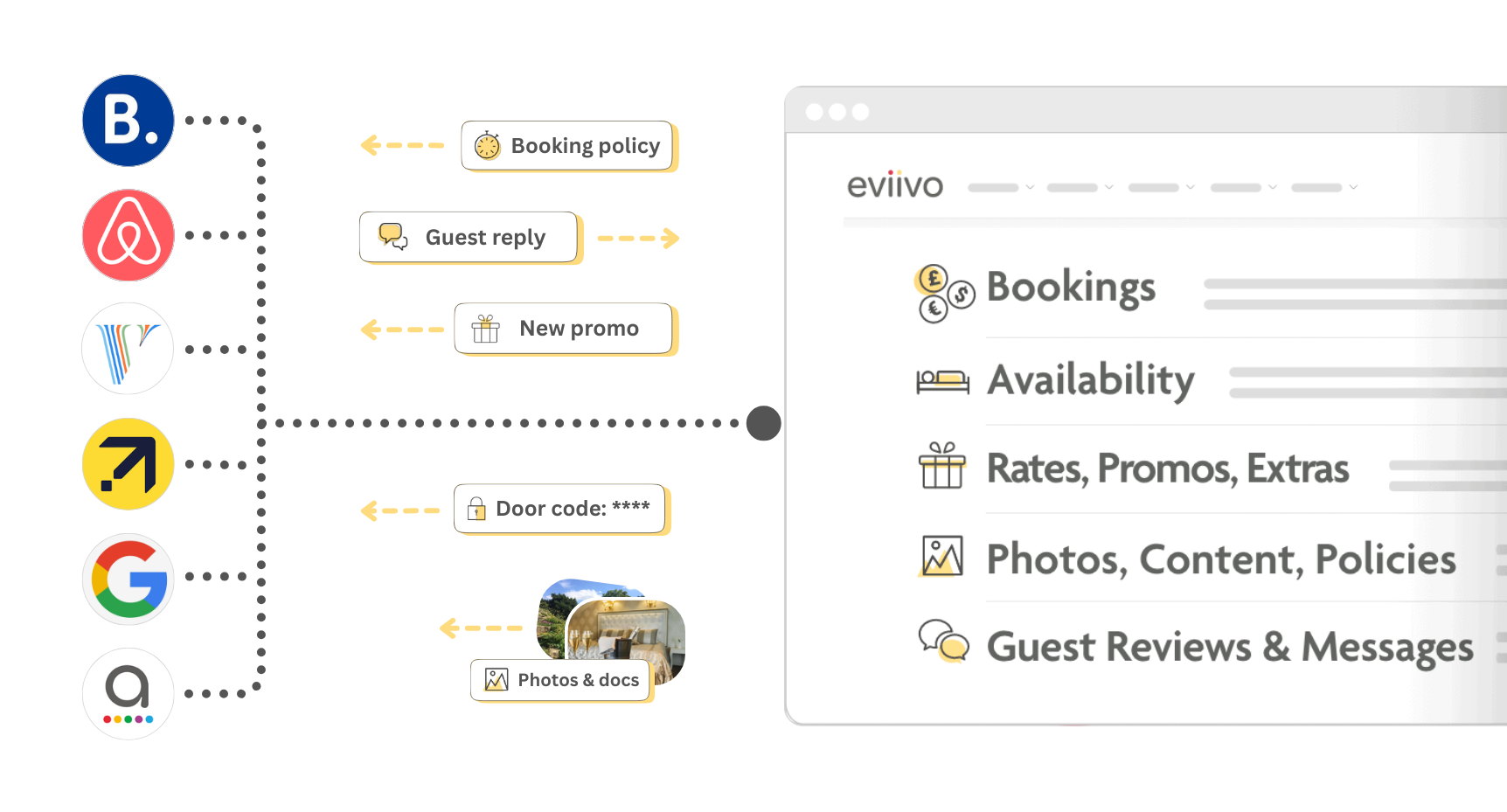
Une différence majeure pour les hôtels qui comparent eviivo et Cloudbeds réside dans l’étendue de leur connectivité avec les OTA sur les canaux les plus performants. Si Cloudbeds synchronise les ARI et les messages des clients, il ne synchronise pas entièrement les politiques d’acompte et d’annulation avec les OTA, ni le contenu et les photos avec des plateformes telles que Booking.com. En revanche, les intégrations API complètes d’eviivo avec les principaux canaux – tels que Booking.com, Expedia, Airbnb, Vrbo, Agoda et Google – couvrent :
- Tarifs, disponibilités et inventaire
- Contenu complet (par exemple, photos des chambres et de l’établissement, équipements, installations, descriptions)
- Politiques
- Paramètres des taxes
- Frais et suppléments
- Les paiements des OTA et les VCC
- Les messages et avis des clients
- Les modifications de réservation
- Les promotions
Avec eviivo, il vous suffit d’effectuer une seule mise à jour centralisée depuis le PMS, qui est automatiquement répercutée sur les OTA connectées et mise en ligne. Cette connectivité approfondie fait d’eviivo une alternative de choix pour les hôtels qui sont référencés sur les principales OTA mais souhaitent réduire le travail manuel répétitif lié aux mises à jour.
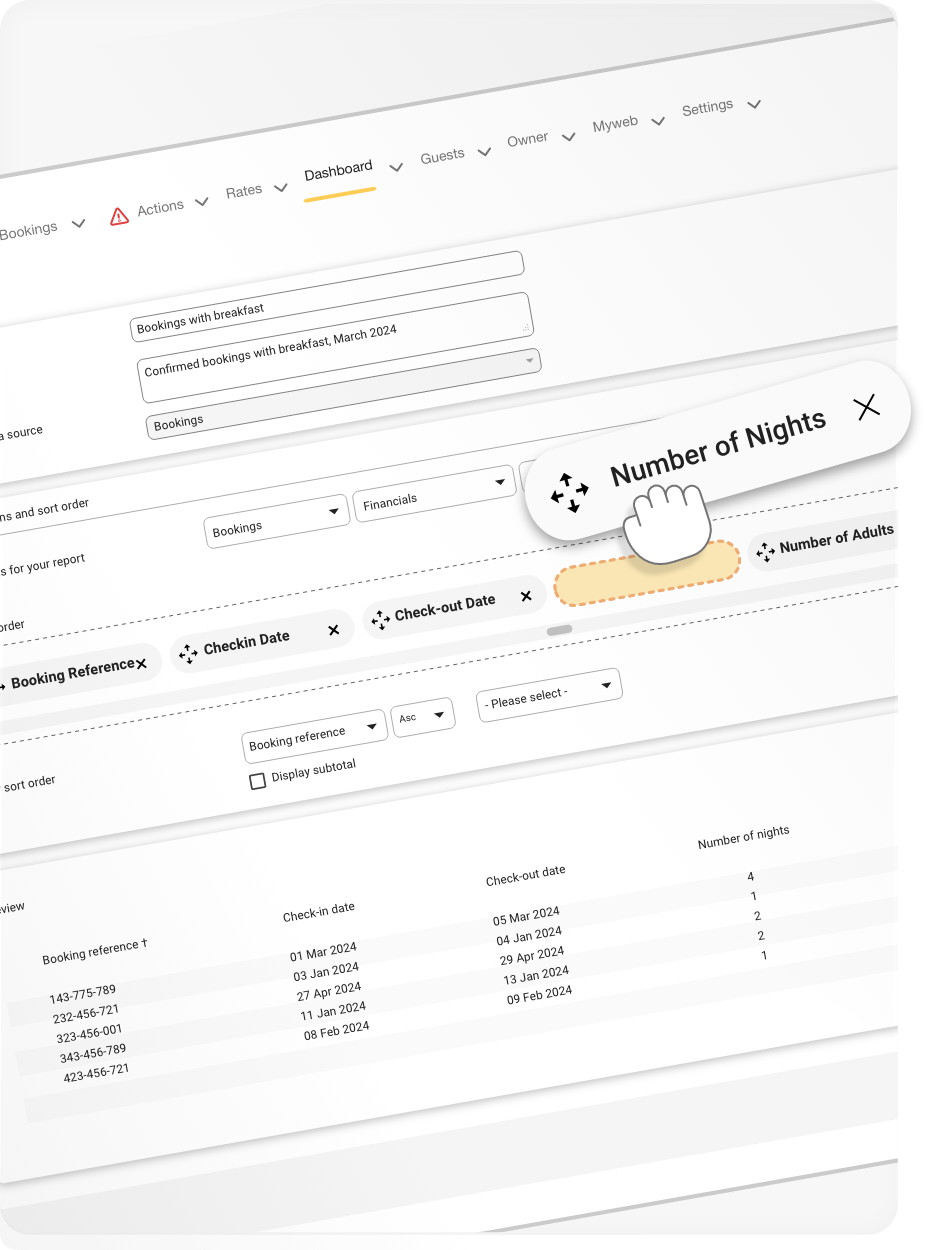
Cloudbeds et eviivo se distinguent également par la richesse de leurs rapports et la visibilité financière qu’ils offrent. Certains avis d’utilisateurs indiquent que les rapports de Cloudbeds manquent parfois d’options de personnalisation et de détails suffisants. Grâce à l’outil Performance Manager d’eviivo, les hôtels peuvent évaluer rapidement leurs performances sur des tableaux de bord en temps réel ou approfondir leur analyse à l’aide de rapports avancés et personnalisables. Des paramètres facilement ajustables vous aident à filtrer les données par type de chambre, établissement, plage de dates, canal ou plan tarifaire, ce qui permet une analyse plus claire des indicateurs clés de performance (KPI) tels que le taux d’occupation, le prix moyen par chambre (ADR), le revenu par chambre disponible (RevPAR), le rythme de prise de réservation et le nombre de réservations quotidiennes. Plutôt que d’obliger le personnel à extraire des données de multiples états distincts, eviivo consolide les données opérationnelles et financières dans des rapports pratiques, y compris des exportations prêtes à l’emploi pour la comptabilité.
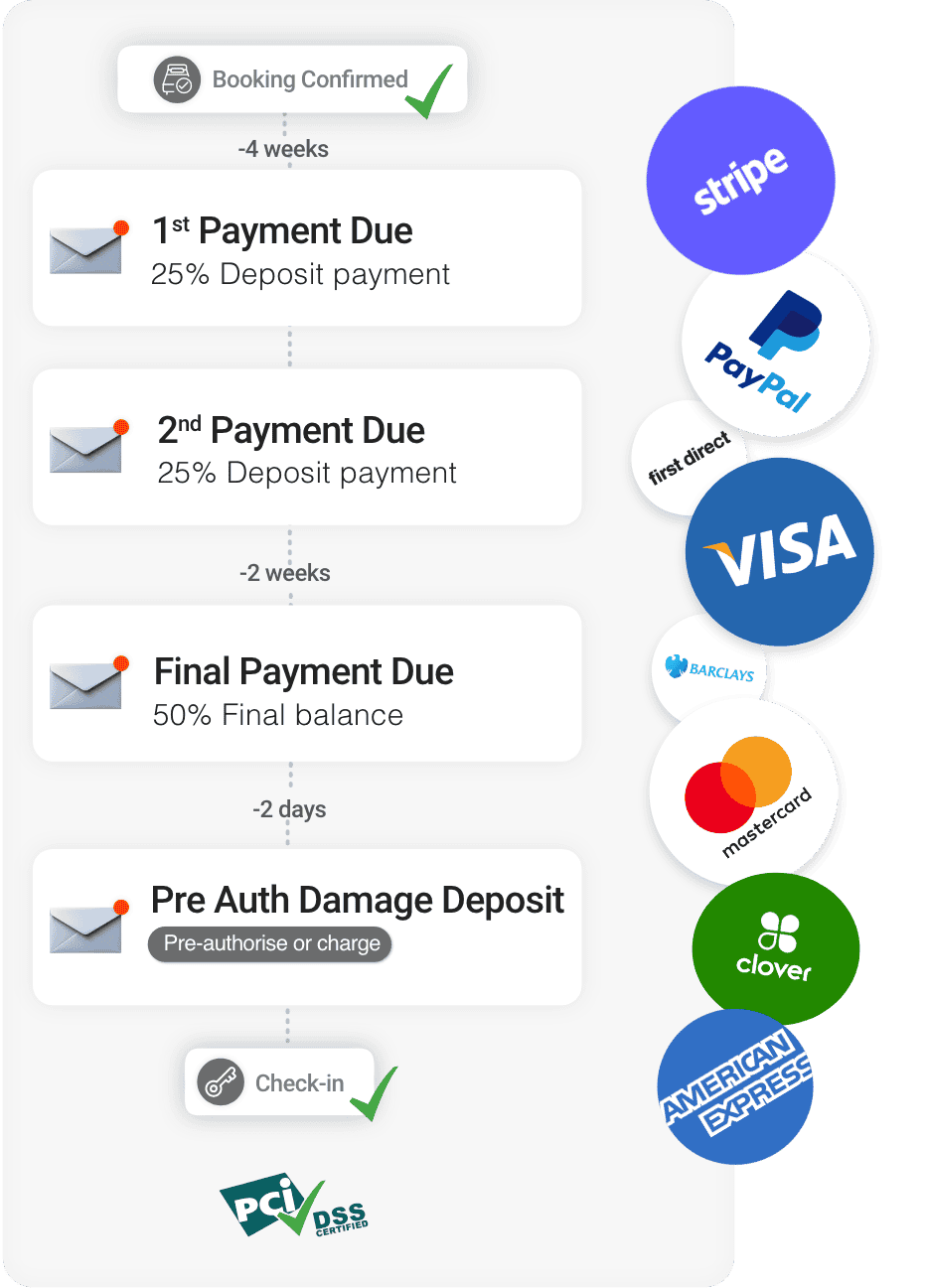
Étant donné que des frais de traitement des paiements s’appliquent à chaque réservation, la flexibilité du prestataire de services de paiement (PSP) est un facteur de comparaison important pour contrôler les marges. Cloudbeds prend en charge neuf passerelles de paiement, bien que les processeurs disponibles varient selon les régions, ce qui oblige les opérateurs dans des zones telles que l’Europe à choisir entre deux options : Cloudbeds Payments ou Stripe. Alors que certains PMS limitent les options de PSP ou appliquent des frais supplémentaires pour la connexion à d’autres passerelles, eviivo s’interface avec plus de 50 prestataires de paiement mondiaux, dont Stripe, PayPal, Worldline, Clover, Worldpay, Fiserv et bien d’autres, offrant ainsi aux hôtels une plus grande flexibilité géographique et la possibilité de réduire les frais de transaction grâce à un choix plus large de prestataires.
Les fonctionnalités d’automatisation et d’IA d’eviivo aident les hôtels à améliorer leur efficacité opérationnelle au quotidien. Par exemple, les messages des clients provenant des OTA et des réservations directes sont regroupés dans une boîte de réception unifiée, avec des suggestions de réponse assistées par l’IA et un service de conciergerie disponible 24h/24 et 7j/7 capable de répondre automatiquement aux demandes des clients sur le web. De plus, eviivo automatise le calcul des commissions, le traitement des cartes de crédit virtuelles (VCC), la gestion des acomptes, l’enregistrement et la comptabilisation automatisés des revenus différés, ainsi que les prélèvements programmés (même après une modification de réservation), améliorant ainsi la précision opérationnelle et réduisant le traitement manuel.
Pour les établissements hôteliers indépendants qui évaluent des alternatives à Cloudbeds, les intégrations OTA complètes d’eviivo, les rapports consolidés et personnalisables, ainsi que les automatisations financières et de messagerie peuvent permettre de gagner plusieurs heures de travail administratif chaque semaine et d’améliorer l’efficacité opérationnelle. De plus, la gamme plus étendue d’options de processeurs de paiement proposée par eviivo peut avoir un impact significatif sur la rentabilité, grâce à l’amélioration des marges sur l’ensemble des transactions.
Les principales fonctionnalités d’eviivo
- Un PMS complet et tout-en-un : il regroupe la réception, la distribution, le moteur de réservation, la création de sites web, le traitement des paiements, la gestion de l’entretien ménager, les rapports avancés et la messagerie client au sein d’une seule plateforme conviviale
- Large distribution sur les OTA, les metasearch et les GDS : renforce la visibilité mondiale grâce à des connexions étroites avec les principaux canaux, notamment Booking.com, Expedia, Hotels.com, Agoda, Google Hotel Ads, Sabre et Amadeus, offrant ainsi un accès à plus de 600 000 agences de voyage et agences d’affaires
- Tarification dynamique, contrôles avancés des tarifs et des stocks : configurez les tarifs, les restrictions, les règles de tarification dynamique, les blocages de vente, les dates limites de réservation et les promotions par canal ou en masse sur le site web direct et les OTA connectées, avec prise en charge des stocks mutualisés et combinés
- Moteur de réservation et site web : moteur de réservation adapté aux mobiles intégré à un site web d’hôtel gratuit et personnalisable, avec un contenu structuré et une FAQ pour une visibilité LLM et SEO
- Configurations fiscales régionales, conformité et intégrations comptables : prise en charge de la TVA, de la GST et des règles avancées en matière de taxes municipales au sein du PMS, ainsi que des intégrations avec des outils comptables et de conformité, notamment Xero, Intuit QuickBooks, Fiskaly et Swikly
- Assistance en direct et intégration simplifiée : assistance téléphonique et par chat 7 jours sur 7 pour tous les clients, ainsi qu’une intégration rapide grâce à l’importation simple des annonces OTA et des réservations, des guides en ligne et un chatbot disponible 24 h/24 et 7 j/7 pour faciliter la mise en œuvre et la formation du personnel
- Communication unifiée avec les clients : boîte de réception centralisée pour les messages et les avis des clients, avec des réponses générées par IA pour les messages OTA, les demandes directes, les e-mails, WhatsApp et les SMS
- Application PMS mobile : application mobile native primée pour gérer les réservations, les disponibilités, les performances, les opérations de l’établissement et les messages où que vous soyez
eviivo Pricing
- Single Property (from $50/month): Core PMS, Channel Manager, Direct Booking Engine/Website, eviivo Mobile™, native AI
- Multi-Property (from $125/month): All core features plus portfolio management, including multi-property calendar, contact management, and bulk actions across properties
- Fully Integrated Add-Ons (Optional): Automated payments, AI-powered concierge, unified guest messaging, dynamic pricing & promos, performance management, and housekeeping dashboard & owner management
- Volume (Custom): Discounted pricing from 10+ rooms
- Fees: Flat $0.50 per confirmed booking (only with integrated messaging & payments add-ons)
- Unlimited users, transactions and websites
Reviews and Ratings
- HotelTechReport: 4.8 out of 5 – based on 204 reviews
- Trustpilot: 4.6 out of 5 – based on 2,650 reviews
- Capterra: 4.1 out of 5 – based on 392 reviews
What are people saying about eviivo
- “What I like most about eviivo is the perfect balance between ease of use and the depth of features it offers. The platform is extremely intuitive, even for users who are not very tech-savvy. Navigating between reservations, channel management, and property settings feels smooth and logical, which has significantly reduced the time we spend on administrative tasks.” — Verified HotelTechReport review
- “eviivo has been an extremely useful tool for us. We can set up our hotel rooms’ descriptions, photos and prices and edit in one place instead of having to individually enter info on vendor sites. We can also ‘block off’ rooms that are down for maintenance, and we can manage and view bookings in one place. The software is cloud based which means we can do whatever we need to do wherever we are!” — Verified Capterra review
2. Mews – Best for enterprise hotel groups building a customized tech-stack through marketplace integrations
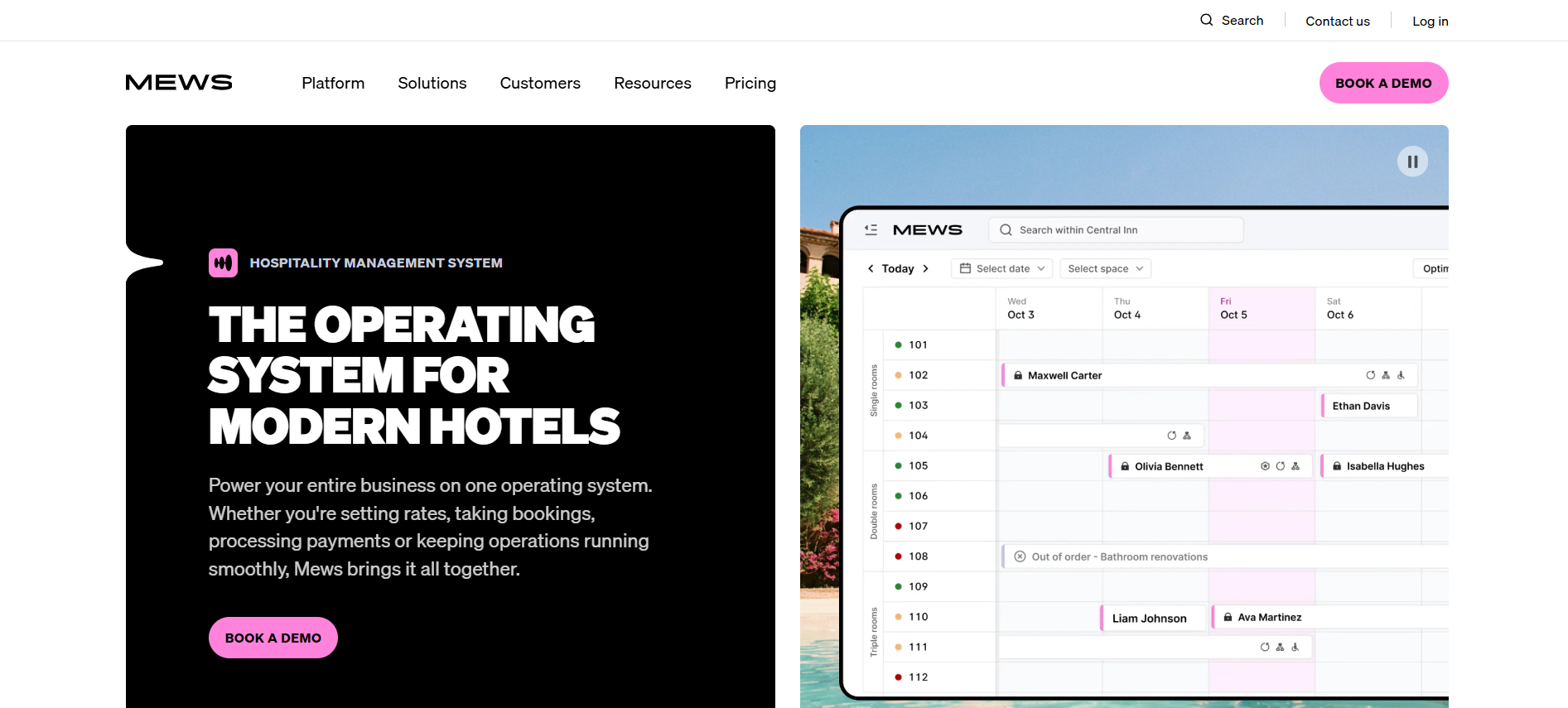
Mews is a cloud-native PMS used by 12,500+ hotels worldwide. Built around an open API architecture, it enables properties to customize their tech stack through extensive third-party integrations while automating front desk, payments, and operational workflows.
The Mews Marketplace and open API framework allow hotels to connect with more than 1,000 third-party tools, including for distribution, revenue management, and guest messaging – compared to 400+ integrations offered by Cloudbeds. This makes it easier for properties already operating a multi-vendor technology configuration to retain existing tools when transitioning to Mews. Its emphasis on integration flexibility positions Mews as a modular architecture alternative to Cloudbeds for hotels seeking greater system customizability.
Mews supports self-service guest journeys, with capabilities including contactless check-in /check-out and kiosk-based arrivals to reduce front-desk management. While Mews reports Cloudbeds does not offer proprietary kiosks, Mews Kiosk can issue room keys on-site and enable direct messaging with reception. If your hotel business is seeking to automate arrivals, reduce front desk workload during peak periods, or operate with leaner staffing models, Mews Kiosk and other built-in self-service features may represent an operational differentiator.
Mews also supports revenue streams beyond the room rate. Modules for POS, events, and bookable services tie on-property spend (e.g., parking, meeting spaces, experiences, F&B) directly to guest profiles and folios, so all charges appear on a single bill and staff can see complete spend history in one view.
Mews is best suited to hotel groups that prioritize modular architecture and marketplace integrations, particularly those with IT teams capable of managing a multi-vendor technology stack. However, maintaining integrations to extend core functionality may increase your operational complexity or overall technology costs, which may not suit small to mid-sized hotels, where an all-in-one PMS is often sufficient in covering and streamlining operations.
Mews Features
- Cloud-native front-desk management: Central calendar to manage reservations and check-ins, plus automations for some routine front-desk tasks
- Mobile-first housekeeping tools: Enables staff to update room status, log repairs, and record minibar usage directly from mobile devices
- Mews Marketplace: Connects with 1,000+ third-party tools across channel management, revenue management, guest messaging, marketing, and more
- Integrated booking engine: Supports direct online reservations to help reduce reliance on OTAs
- Self-service kiosk features: Mews Kiosk enables contactless check-in and check-out, allowing guests to manage reservations and collect room keys on-site
- Ancillary revenue management: POS, events, and bookable services linked directly to guest profiles and folios for consolidated billing
Mews Pricing
- Mews does not display pricing on their website. Contact them directly for a custom quote
- Essentials plan: Core PMS, booking engine, guest portal for online check-in, embedded payments, front office tools (including Mews Kiosk), exportable reports, up to eight Marketplace integrations, and chatbot support
- Advanced plan: Includes everything in Essentials, plus enhanced guest experience tools, AI-driven guest summaries, customizable booking engine, automated SMS reminders, Digital Key functionality, and branded communications
- Enterprise plan: Includes everything in Advanced, plus Mews Analytics, Open API access, unlimited Marketplace integrations, and no implementation fees
- No free trial available
Reviews and Ratings
- HotelTechReport: 4.6 out of 5 – based on 878 reviews
- Trustpilot: 3.3 out of 5 – based on 78 reviews
- Capterra: 4.6 out of 5 – based on 57 reviews
3. Amenitiz – Best for hotels seeking a channel manager for basic ARI distribution
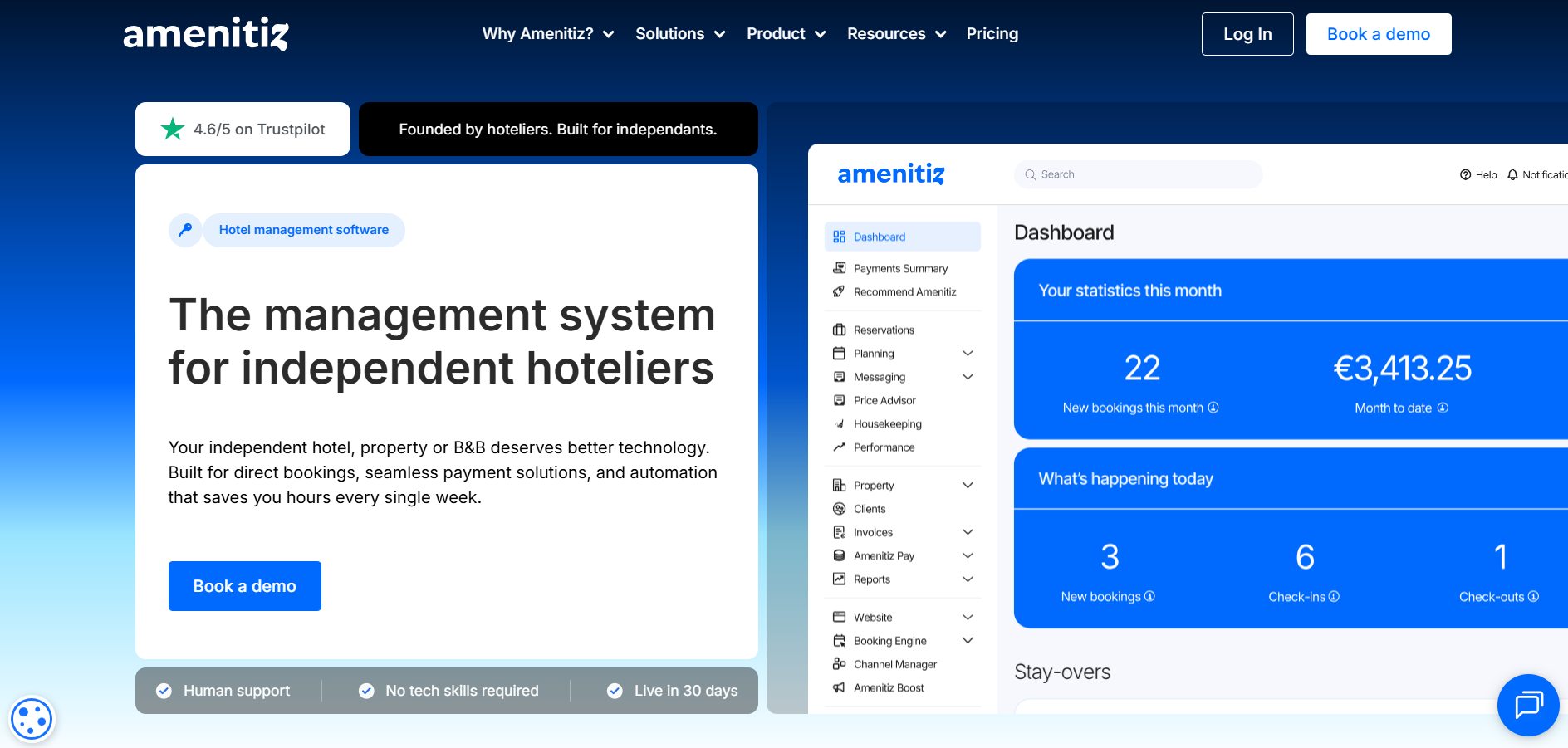
Amenitiz is a cloud-based hotel management platform built for Europe-based hotel operators who want to manage core operations from a single system. Used by 15,000+ properties, it is designed for teams that prioritize simplicity over modular customization, broad feature sets, or advanced configurations.
Compared to Cloudbeds, which supports a broader range of property sizes and more flexible integration configurations, Amenitiz primarily serves independent hotels with approximately 1130 rooms. Additionally, while Cloudbeds works with hotels globally, Amenitiz’ built-in invoicing – with support for local regulatory requirements such as SEF reporting in Portugal – is particularly aligned with European properties that require EU-specific compliance.
Another point of comparison is each platform’s OTA connectivity and guest messaging scope. While Amenitiz connects to 120+ OTAs for rate and availability synchronization, its unified inbox currently syncs guest messages for two platforms: Booking.com and Airbnb. In contrast, Cloudbeds supports unified messaging across a broader range of channels and includes SMS and WhatsApp messages capabilities. For hotels that rely mainly on Booking.com and Airbnb alongside direct bookings, and do not intend to use WhatsApp or SMS for communication, Amenitiz’s more streamlined messaging scope may be sufficient.
Amenitiz also includes: housekeeping management; automated check-in and check-out capabilities; performance dashboards for tracking occupancy and revenue trends; and a dynamic pricing tool (PriceAdvisor) to provide rate recommendations based on seasonality and competitor data.
Amenitiz may align well with smaller European hotels seeking a streamlined platform for core reservations, ARI distribution, and EU-specific compliance, especially where operational simplicity is favored over deeper reporting, automation or integrations.
Amenitiz Features
- Booking engine: Fully integrated booking engine embedded into the hotel’s website, with real-time availability updates
- Website builder: Built-in website creation tool, with integrated booking flow and SEO configuration options
- AmenitizPay: Integrated payment solution supporting online deposits, payment requests, and centralized reservation billing.
- AmenitizBoost marketing tool: Optional campaign management feature to drive additional visibility and bookings
- Housekeeping management: Tools to update room status, manage cleaning schedules, and coordinate operational tasks
- Built-in Invoicing & Compliance Support: Native invoicing with support for certain local regulatory requirements (e.g., SEF reporting in Portugal)
Amenitiz Pricing
- Amenitiz does not display pricing on their website. Contact them directly for a custom quote
- Presence: Website builder, training & tutorials, and customer support
- Sales Pro: Includes everything in Presence plan, plus booking engine with online payments, channel manager, PMS, AmenitizPay, PriceAdvisor (dynamic pricing), and support
- Ultimate+: Includes everything in Sales Pro plan, plus custom SEO-ready website
- No free trial available
Reviews and Ratings
- HotelTechReport: 4.2 out of 5 – based on 43 reviews
- Trustpilot: 4.5 out of 5 – based on 4,707 reviews
- Capterra: 4.3 out of 5 – based on 232 reviews
4. Little Hotelier – Best for small properties that want broad OTA distribution
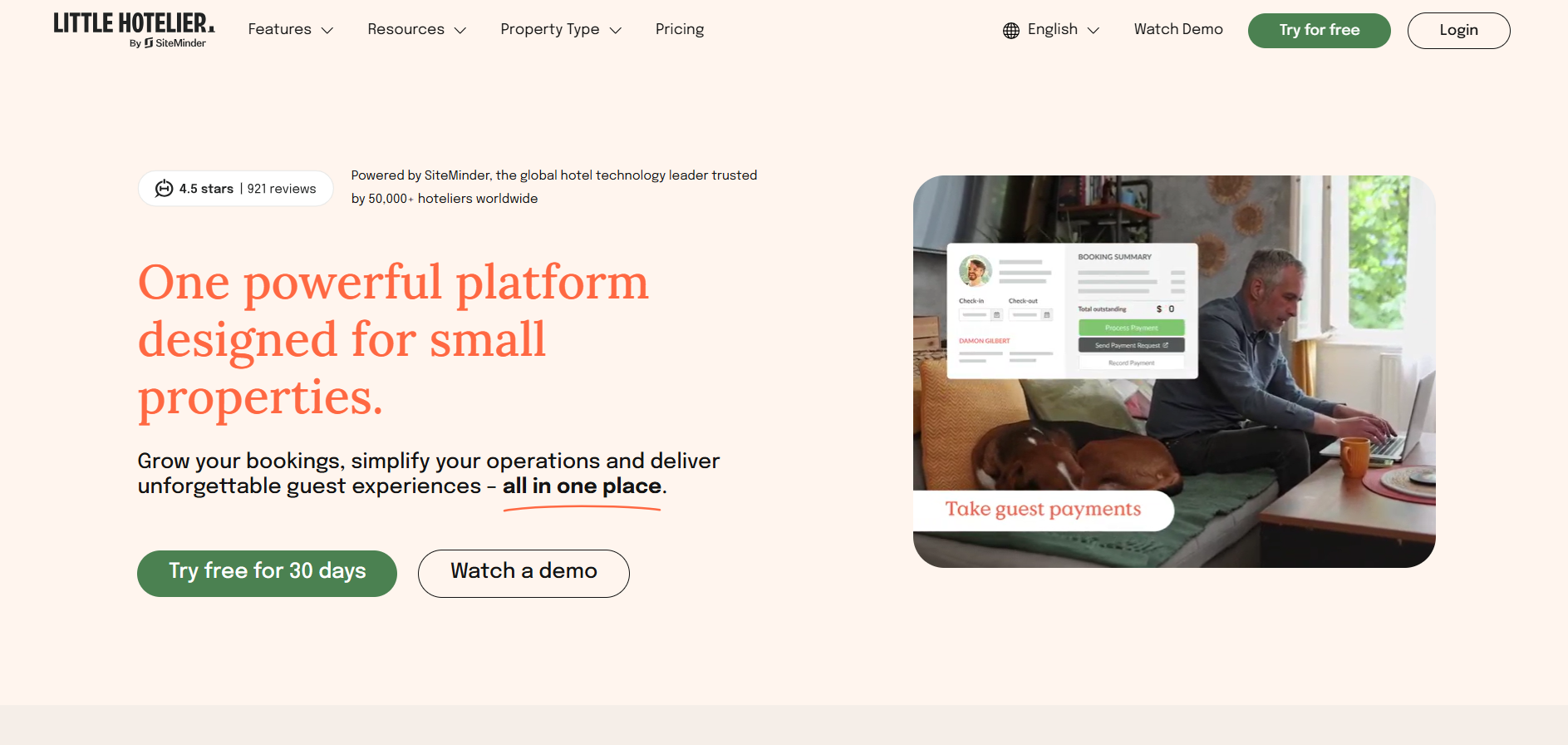
Little Hotelier is a cloud-based PMS, built specifically for small accommodation providers, that serves 50,000+ guesthouses, B&Bs and inns worldwide. It integrates basic front desk operations, reservations, payments, booking engine, website tools, and distribution within a single platform.
Little Hotelier connects properties to more than 450 online booking channels worldwide, compared with the 300+ supported by Cloudbeds. Using SiteMinder’s channel management technology as its underlying distribution engine, Little Hotelier supports real-time, two-way synchronization of ARI across major distribution sites such as Booking.com, Expedia, and Google, as well as regional platforms. For small properties hoping to achieve broad, global visibility, this synchronization model can reduce administrative workload.
Another point of difference is target hotel size. Whereas Cloudbeds aims to support a wider range of property sizes and deeper configuration possibilities, Little Hotelier reports that its software is specialized for properties between 1-30 rooms. As a result, independently-operated properties with a limited number of rooms may find Little Hotelier’s level of functionality better scaled to their needs.
To reduce manual reservation tasks and overbooking risk, bookings from all sources automatically update Little Hotelier’s central PMS calendar, which connects across channels and direct booking engine. The booking engine is directly integrated with the platform’s website builder, which features customizable templates, automated hosting, SSL security, and mobile-optimized pages that allow properties to publish and maintain their website without coding skills.
While Cloudbeds may offer deeper configuration possibilities for larger hotels, Little Hotelier is a good fit for hotels with fewer than 30 rooms seeking core operational tools alongside broad OTA connectivity (via its SiteMinder integration) in a simple system.
Little Hotelier Features
- All-in-one PMS: Centralized calendar to manage reservations, check-ins/outs, room availability, guest profiles, and billing in one interface
- Channel manager: Connect to 450+ OTAs and metasearch channels (via SiteMinder) for real-time, two-way ARI synchronization across major and regional booking platforms
- Direct booking engine: Drive bookings through direct website, social media, and metasearch channels, with automatic availability updates
- Pricing and demand alerts: Instant pricing notifications and demand signals help staff stay informed about relevant demand changes and market trends
- Mobile app: Adjust rates, manage bookings, and monitor availability remotely
- Online check-in forms: Provide guests with a self-service, contactless option to help reduce administrative work for front-of-house teams
Little Hotelier Pricing
- Basics (from $39 per month + 1% fee per booking): Channel Manager, Booking Engine, Calendar, Mobile App
- Pro (from $179 per month): All Basics features plus Competitor Rate Intelligence, Rate Parity Insights, Payments, Hotel Metasearch, Channels Plus
- Revenue Optimiser (from $179 per month + booking fee after promo): All Pro features plus Dynamic Revenue Plus (pricing recommendations and market intelligence)
- 30-day free trial is available
Reviews and Ratings
- HotelTechReport: 4.6 out of 5 – based on 1,766 reviews
- Trustpilot: 4.3 out of 5 – based on 571 reviews
- Capterra: 4.0 out of 5 – based on 220 reviews
5. roommaster – Best for integrated reporting and ampliphi RMS connection
roommaster provides hotel software used by more than 5,500 independent hotels globally, helping consolidate operations within a single system, including: reservations, front desk operations, housekeeping, maintenance tracking, and financial management.
Both Cloudbeds and roommaster offer revenue management tools for automated rate optimization, making it an important area for deeper evaluation. roommaster integrates with ampliphi to offer demand-based pricing optimization and AI-driven insights, while Cloudbeds delivers AI-driven forecasting and pricing recommendations through its Signals product to provide predictive analytics and market intelligence. While both platforms provide revenue optimization support, hotels should research whether ampliphi or Signals is their preferred system.
Reporting is another area of differentiation. roommaster includes over 125 built-in reports and visual performance dashboards, supporting detailed financial, operational, and revenue analysis. While Cloudbeds offers a high number of reports, some user reviews suggest they may lack consolidation to support practices such as bookkeeping. This might make roommaster better suited for hotels seeking faster access to export-ready data.
To fill in any functionality gaps not covered by either PMS, Cloudbeds offers a broader marketplace ecosystem of over 400+ integrations versus 150+ third-party integrations offered by roommaster. For hotels that plan to use more niche hospitality software, Cloudbeds’ broader integrations marketplace may be a better fit for stronger coverage, whereas properties seeking to streamline their tech overhead may prefer an all-in-one PMS with advanced built-in features, to cover their core needs, such as roommaster.
Hotels that require a wide range of reports to support data-driven decision making and wish to use ampliphi as their RMS of choice are well-suited to roommaster as a PMS alternative.
roommaster Features
- Unified reservation management: Color-coded calendar with real-time synchronization across booking engine and channel manager to prevent double bookings and track room status
- Group booking controls: Custom rules for weddings, corporate events, and sports teams, including flexible billing and group-specific reporting
- Guest profile management: Store stay history, preferences, and spending data in an embedded CRM
- Integrated booking engine: Direct booking tools with upsell options, group widgets, and built-in payment gateway support
- Financial management: Direct billing, group billing flexibility, integrated payment processing, and transaction-level financial tracking
- Marketplace connectivity: Access to 150+ partner integrations to extend system functionality
roommaster Pricing
- roommaster does not display pricing on their website. Contact them directly for a custom quote
- No free trial available
Reviews and Ratings
- HotelTechReport: 4.4 out of 5 – based on 142 reviews
- Trustpilot: N/A – fewer than 5 reviews
- Capterra: 4.3 out of 5 – based on 129 reviews
6. RoomRaccoon – Best for flexible ancillary inventory configuration
RoomRaccoon is a cloud-based hotel management system (HMS) for properties aiming to improve their online visibility and expand their revenue streams. Its channel manager connects properties to 200+ distribution channels,including OTAs, GDSs and bedbanks, while an integrated booking engine supports direct booking growth.
One differentiator between Cloudbeds and RoomRaccoon is the latter’s ability to sell alternative spaces. In addition to guestrooms, RoomRaccoon’s inventory configuration options enable hotels to sell spaces such as parking spots, co-working desks, or other ancillary assets directly through the system, something RoomRacoon reports Cloudbeds does not offer. Revenue managers may view RoomRaccoonpositively as an alternative HMS if aiming to diversify revenue by selling underutilized spaces.
Another differentiator to consider is the ability to set rate-level deposit and cancellation policies. RoomRaccoon provides the ability to assign different pre-payment requirements to individual rate plans – for example, configuring some rates with 100% pre-payment for non-refundable bookings, or pay-on-arrival for cancelable options. By contrast, RoomRaccoon reports that Cloudbeds isn’t able to offer rate-level specification of pre-payment requirements, meaning hotels that want to increase customer choice and cash-flow predictability may prefer an alternative offering greater payment rule configuration.
For independent hotels managing high guest turnover with limited staff resources, RoomRaccoon also supports online check-in and check-out, plus digital ID and passport scanning that auto-populates guest details. These features increase process automation across arrival, registration, and compliance workflows by enabling customers to complete forms online with minimal-to-no staff intervention.
Overall, RoomRaccoon may appeal most to independent hotels seeking a PMS that helps diversify income streams through ancillary spaces configuration and offers rate-level prepayment logic to help clear payment segmentations.
RoomRaccoon Features
- Channel manager: Two-way rate and availability synchronization across 200+ OTAs, GDSs, metasearch engines, and bedbanks
- Revenue management: Built-in dynamic pricing tools (RaccoonRev) to support with yield management
- Direct booking engine: Mobile-friendly booking engine with add-ons, packages, discount codes, and optional white-label branding
- Integrated payments: Payment links, automated deposits and pre-authorizations, centralized VCC monitoring, and integrated card machine support
- RaccoonID: Online check-in and check-out, plus digital ID and passport scanning for guest journey automation
- Website builder: Create and manage a hotel website with built-in booking engine connectivity using RaccoonSite
RoomRaccoon Pricing
- Entry (from $207 per month): Core PMS, channel manager, booking engine, and integrated payments
- Essentials (from $262 per month): Includes everything in Entry, plus additional users, expanded booking channel access, dynamic pricing functionality, and one upgrade tool or integration
- Premium (from $387 per month): Includes everything in Essentials, plus unlimited booking channels, expanded dynamic pricing rules, advanced revenue reporting, 7-day phone support, and three upgrade tools or integrations
- Pro (from $542 per month): includes everything in Premium, plus unlimited users, financial reporting, priority support SLA, RaccoonRev Plus, unlimited upgrades, and unlimited third-party integrations
- Access to a demo account is available for a 14-day period
Reviews and Ratings
- HotelTechReport: 4.8 out of 5 – based on 208 reviews
- Trustpilot: 4.2 out of 5 – based on 282 reviews
- Capterra: 4.2 out of 5 – based on 72 reviews
7. ResNexus – Best for booking engine merchandising and guest blacklisting
ResNexus is a cloud-based hospitality software platform used by thousands of properties worldwide, including independent inns, campgrounds, vacation rentals, and small hotels. ResNexus combines property management, channel management, direct booking tools, credit card processing, and website services within a single ecosystem.
The guest’s online purchasing experience is a key approach difference between ResNexus and Cloudbeds’ respective booking engines. ResNexus shows booking add-ons (e.g. retail items or packages) during the booking process on side-bars as pre-cart upsells, while Cloudbeds shows add-ons after the reservation is complete. Additionally, ResNexus’ booking engine employs cookies to remember guest selections – such as room or unit selection – between sessions, as opposed to starting over again. Combined, these features may make ResNexus a good alternative to Cloudbeds for properties that aim to increase booking conversions and upsells, with more prominent merchandising throughout the guest journey.
ResNexus can also help properties make specified guests ineligible for future direct reservations. The HMS permits hotels to ban a guest from making bookings via the direct booking engine and flags banned guests to staff when using the customer CRM. ResNexus reports that while Cloudbed’s booking engine enables properties to flag disallowed guests, it doesn’t operate an automated booking prevention mechanism, meaning staff may need to manually cancel banned guest bookings. Hotels that have recurring issues with problematic guests may benefit from automated guest booking prevention via direct websites, though properties should note this may not prevent bookings made via other channels.
ResNexus also supports dynamic pricing adjustments, smart minimum-night rules, and automatic rate adjustments based on occupancy and time of bookings. For independent lodging operators seeking automated rate optimization and yield management tools, ResNexus offers some core tools within their cloud platform that don’t require external revenue management software.
ResNexus is a good fit for inns and independent operators seeking stronger booking engine merchandising and direct guest controls within a core PMS platform.
ResNexus Features
- Travel protection: Optional guest-paid travel protection managed by ResNexus, offering up to 100% reimbursement for emergency cancellations (e.g., illness, injury, travel delays) and up to 75% for “any reason”
- OTA channel manager: Real-time synchronization with major sites, including Booking.com, Airbnb, Vrbo, Expedia, Google, and Tripadvisor
- Guest booking controls: Ability to prevent banned guests from completing direct online bookings and flag disallowed guests within the CRM
- Automated email marketing: Pre-configured confirmation, welcome, thank you, birthday, anniversary, and promotional emails to support guest retention
- Integrated housekeeping module: Built-in housekeeping management to coordinate room turnover and task tracking
- Responsive website: Templated or custom websites with hosting, SSL security, ADA-friendly setup, and integrated booking engine
ResNexus Pricing
- ResNexus does not display pricing on their website. Contact them directly for a custom quote
- Channel Manager Edition: Channel manager, booking engine, reservation calendar, and phone support
- Essentials Edition: Includes everything in the Channel Manager Edition, plus PMS, housekeeping, 100+ operational and financial reports, revenue management tools, automated guest emails
- Premier Edition: Includes everything in Essentials plan, plus opt-in email marketing, specials and packages management, booking engine sidebars, group reservation management, cart abandonment recovery tools, built-in point-of-sale (POS), contactless check-in/out, Housekeeping Pro, night audit functionality, and integrated contracts
- 30-day free trial is available
Reviews and Ratings
- HotelTechReport: 4.8 out of 5 – based on 215 reviews
- Trustpilot: N/A – fewer than 5 reviews
- Capterra: 4.8 out of 5 – based on 426 reviews
Key Evaluation Criteria When Comparing PMS Options
When exploring alternatives to Cloudbeds, owners, general managers and IT teams should focus on software that provides strong automation, clear reporting, reliable financial controls and streamlined operations. Be sure to evaluate the following areas in detail:
1. Channel Control and Synchronization Depth
Look beyond whether the system simply “connects” to major OTAs. Instead, assess how much data is actually synchronized and can be centrally controlled from within the PMS.
Some platforms update only availability, rates and inventory (ARI), while others also distribute policies, taxes, promotions, room- and property-level photos, amenities, guest messages and more – reducing (or even eliminating) the need to make repetitive OTA-by-OTA changes in extranets.
Stronger, centralized channel control means fewer discrepancies across platforms, less manual work, and hours saved per week with full OTA automation.
2. Reporting and Reconciliation
Clear financial visibility is essential for operational decision-making and accounting accuracy. Consider whether the PMS:
- Automates commission and fee calculations
- Handles virtual credit card (VCC) processing and reconciliation automatically
- Generates accounting-ready exports
- Allows you to build custom reports
- Supports flexible group billing and invoice adjustments
The depth of financial logic embedded in a PMS – including how revenue is allocated and recalculated when reservations change – can significantly reduce manual adjustments and your team’s dependency on spreadsheets.
3. System Architecture and Operational Infrastructure
Assess whether all the functions needed to operate your hotel are available within a single, unified system, or whether the PMS depends on layered third-party integrations.
Having fewer moving parts can improve the system’s reliability, support staff familiarity, reduce the need for complex maintenance work, and keep data secure.
4. Revenue Capture and Cost Structure
Beyond features and functionality, evaluate how the PMS may impact long-term margin and cost predictability. Consider:
- Flexibility in choosing or negotiating payment service providers (PSP)
- Transparency of transaction, subscription and add-on fees
- Overall total cost of ownership as booking volume fluctuates
Control over revenue capture and payment processing structure can meaningfully influence your hotel’s profitability over time.
eviivo: A comprehensive, all-in-one Cloudbeds alternative for independent hotels seeking deeper operational control
Different PMS alternatives address different operational needs. Some focus on modular architecture, while others emphasize deep, all-in-one systems combining all core tools.
The right choice depends on whether your hotel needs incremental feature additions, or comprehensive, centralized control across distribution, reporting, payments, and automation.
Hotels may start comparing Cloudbeds competitors when they need deeper OTA synchronization, more customizable and detailed reporting, simpler financial reconciliation, or greater control over pricing and payment configurations. A key consideration for any hotel is that fragmentation across reporting, extranets, and third-party tools – especially as distribution complexity grows – can significantly increase your administrative workload and margin pressure.
By combining full-content OTA automation synchronization (not just ARI), advanced customizable reporting, integrated payment flexibility with 50+ PSP options, and unified guest communications within one system, eviivo provides independent hotels with a more centralized operational model – and more transparent, predictable costs – than systems built primarily around layered integrations.
If your goal is to eliminate repetitive OTA updates, consolidate reporting, and manage all core hospitality operations from one unified system, book a free demo with eviivo today.
All information in this article is accurate at the time of publication and is based on publicly available sources and user feedback.
 Vous pourriez également être intéressé par...