Everywhere you look, AI is dominating conversations about hospitality technology. According to research from Canary Technologies, 71% of operators say AI is having a significant or transformative impact on the industry.
Yet amid all the excitement, another technology with an established record of improving operational efficiency is at risk of being overlooked: automation.
Ultimately, AI and automation share a fundamental purpose: reducing manual workloads, improving efficiency, and giving accommodation businesses more time to focus on guests and business growth.
But confusing the two – or neglecting automation entirely at the expense of AI – risks leading accommodation providers to invest in additional technology that’s costly to implement, unwieldy to manage, and poorly suited to their operational needs.
For independent hotels and short-term rental operators, choosing the right technology doesn’t mean choosing between AI and automation. It means understanding where each delivers value, how they complement one another, and why integrating both within a unified platform may be key to unlocking their combined potential.
Automation in hospitality: the reliable pair of hands
Automation refers to technology that performs tasks or processes with minimal human intervention. Typically, it does this by following predefined rules, triggers and workflows.
Therefore, much traditional automation operates according to an established sequence of instructions: when a particular event occurs, the system automatically performs a corresponding action.
It’s this predictability that makes property management automation so valuable in hospitality. As you know, accommodation providers manage countless routine processes that need to be completed accurately and consistently – regardless of your booking volumes, staffing levels, or the time of day.
By automating these processes, you can reduce repetitive administrative work, eliminate opportunities for human error, and maintain guest service standards without continually increasing your team’s workload.
Just consider the actions that need completing between the moment a vacation rental guest makes a reservation and when they arrive. Many of these can be handled automatically:
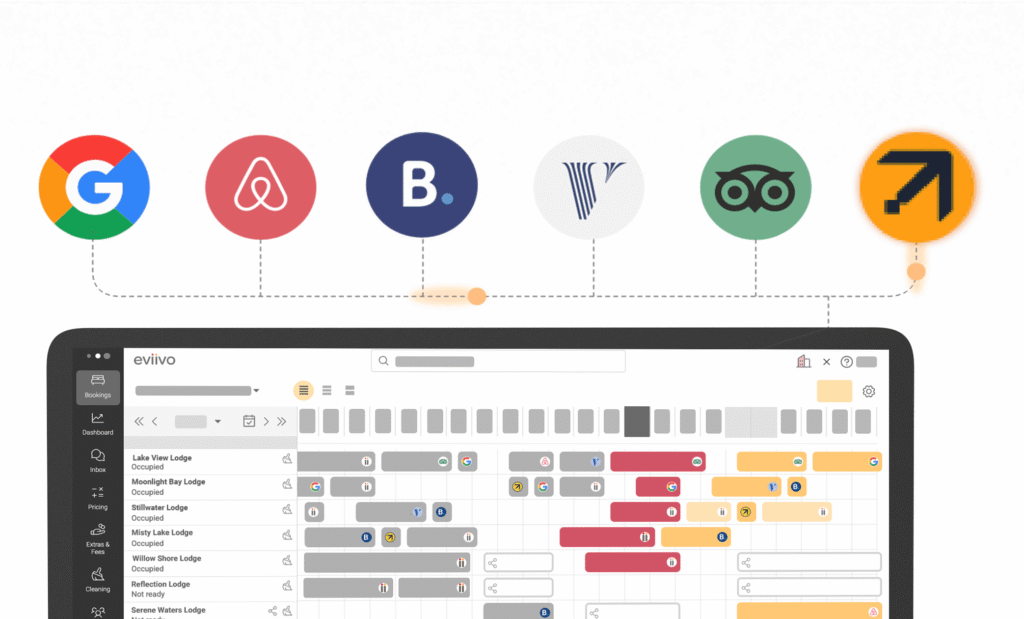
- The guest books a room through the rental’s direct website. Its channel manager immediately updates availability across connected online travel agencies (OTAs) to prevent the same inventory from being sold twice.
- The property’s access management system automatically generates a time-limited entry code linked to the reservation.
- A configured payment workflow collects the required deposit from the guest, in line with the property’s booking and payment policies.
- A pre-arrival email automatically populates with the guest’s reservation details and access code before being sent at a prescheduled time.
Note that none of these actions necessarily requires AI. Instead, they depend on established rules, accurate information and reliable connections between systems (such as the channel manager and its connected OTAs).
However, this reliance on predefined instructions also caps what automation can achieve independently. When circumstances fall outside the established workflows, traditional automation cannot assess the situation, interpret unfamiliar information, or determine whether a different course of action might produce a better result.
That’s where AI introduces a different set of capabilities.
What is AI? The question some accommodations are afraid to ask
Artificial intelligence refers to computer systems capable of performing tasks traditionally associated with human intelligence, including:
- Recognizing patterns
- Interpreting language
- Generating content
- Making predictions or recommendations
Rather than relying exclusively on predefined instructions, modern hospitality AI tools can analyze information, identify relationships, and produce responses informed by the most relevant context.
These capabilities are enabled by several subsets or branches of AI:
- Machine learning (ML): Enables systems to identify patterns in data and develop predictive models, such as forecasting demand or identifying opportunities to optimize room rates.
- Natural language processing (NLP): Allows technology to interpret and respond to human language, making conversational AI guest communications and plain-language interactions with software possible.
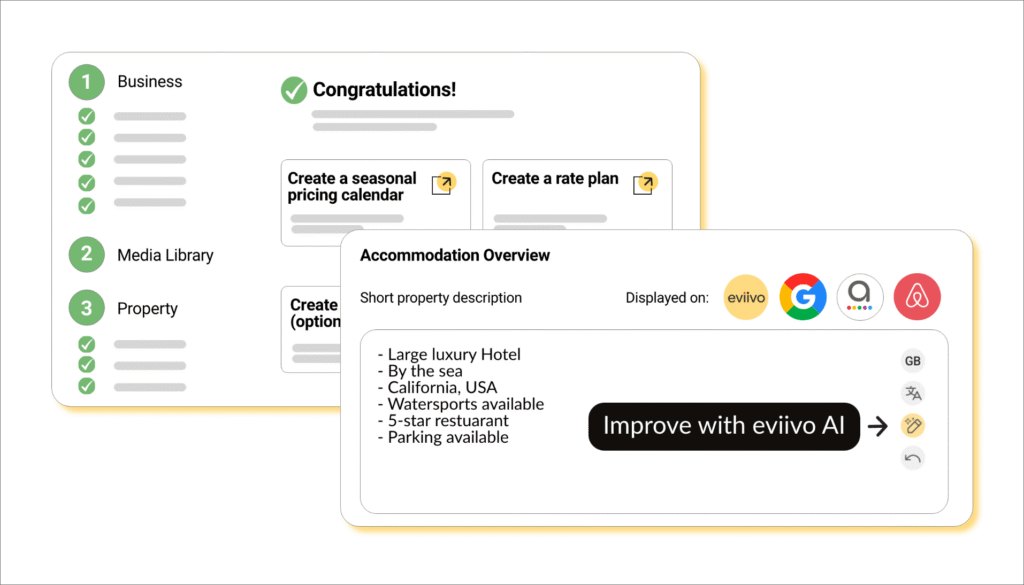
- Generative AI: Produces original outputs, including written responses, translations and marketing content, based on information and instructions provided to the system.
Together, these applications of AI enable accommodation providers to address more complex challenges than traditional automation could resolve through fixed rules alone.
AI vs automation: where they differ, why it matters
The fundamental distinction between AI and traditional automation lies in how they approach tasks, interpret information, and respond to changing circumstances.
Let’s break down the differences, with examples of how the two can tackle key scenarios in your daily operations.
Execution vs. interpretation
Automation follows configured instructions to complete a process consistently. AI can interpret data and contextual information to determine an appropriate response.
For example, automation can send a standard pre-arrival message while AI can draft a personalized answer to an unexpected guest inquiry.
Rules vs. intent
Traditional automation requires an operator to define the conditions that trigger an action. AI can interpret what someone is trying to accomplish, even when their request doesn’t follow a predefined format.
For instance, a guest asking where they can eat in the local area may receive a contextually relevant AI-generated response, rather than an unrelated automated template.
Consistency vs. adaptability
Automation excels when processes remain predictable. AI can respond to changing conditions and recognize patterns that would be difficult to capture through fixed rules.
Here’s a recent real-life example. In one instance, eviivo’s Inherent AI Pricing set a hotel’s breakfast-inclusive rate lower than its non-refundable room-only rate.
It’s highly unlikely that a rule-based automation process would have reached the same conclusion – but the AI algorithm had used real-time data to identify that late-booking guests valued flexibility more than breakfast for those dates.
Predefined actions vs. greater autonomy
Automation executes actions within established workflows. (“When X happens, do Y.”) More advanced AI systems can interpret broader objectives and evaluate the possible approaches before determining the actions needed to achieve the goal.
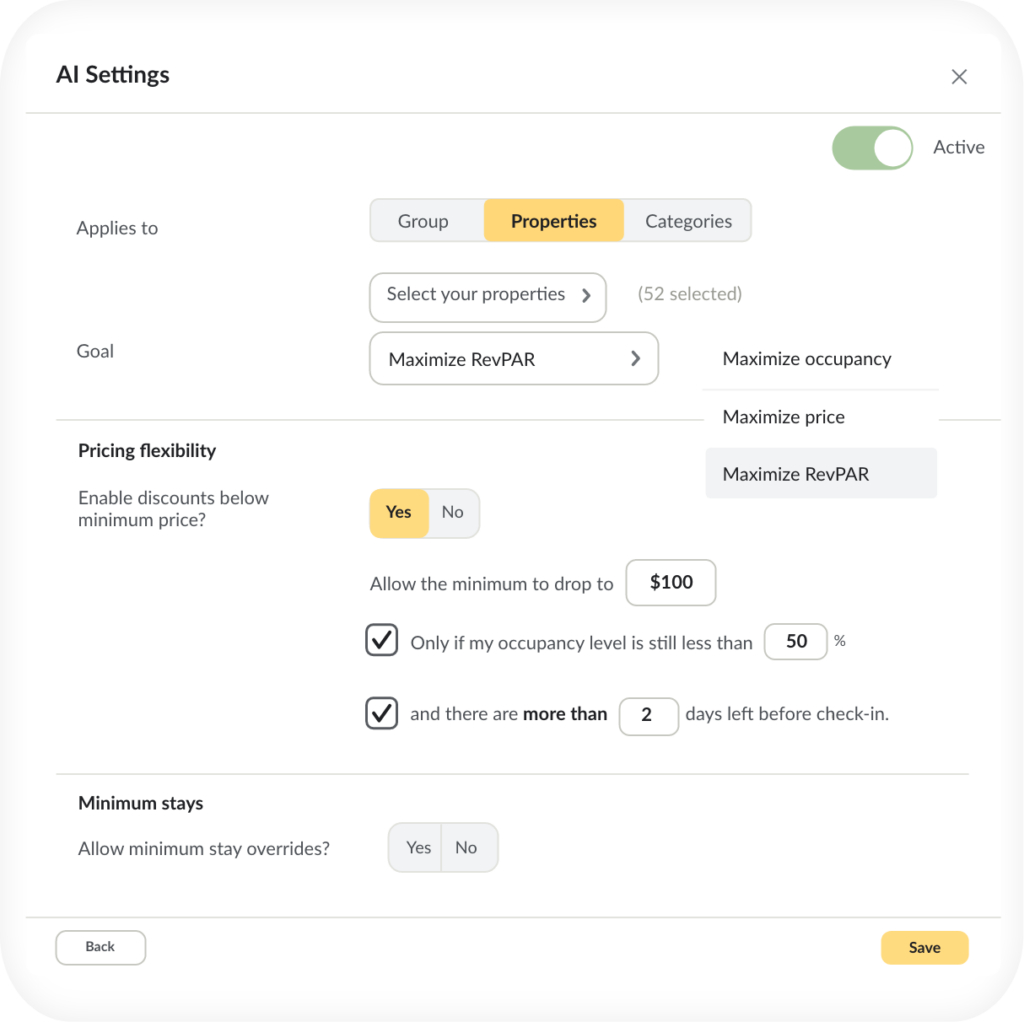
For example, rules-based pricing automation might increase a property’s room rates by 10% when occupancy reaches a predefined threshold. In contrast, eviivo’s Inherent AI Pricing can work toward an operator’s broader revenue or occupancy goals, analyzing demand patterns and market conditions, then determining the most effective pricing rather than simply following fixed rules.
So why do these distinctions matter? Because choosing the wrong technology for a particular task can introduce unnecessary complexity –without improving results.
An accommodation provider doesn’t need sophisticated AI to update room availability across booking channels, calculate city taxes, or pre-authorize guest credit cards.
Equally, a collection of rigid automation rules is unlikely to deliver the flexibility required to optimize pricing against ever-changing market conditions or handle a guest query requiring specific context.
However, the strongest approach for accommodation businesses recognizes that automation and AI technologies are complementary – not competing alternatives.
Bringing it all together: Intelligent automation in hospitality
AI and automation perform different functions. But their greatest value often emerges when they work together.
Think of them as two parts of one extra team member.
AI is the brain: it provides the ability to interpret information, recognize patterns and determine appropriate actions.
Automation is the hands: it provides the mechanisms to execute those actions reliably across your workflows.
Now let’s return to the example of AI-powered revenue management to see how this works in action.
An AI system might analyze demand, booking patterns and commercial objectives to recommend a new room rate.
Automation can then apply that rate within your PMS and distribute the updated pricing across all connected booking channels – without requiring a human to make each adjustment manually.
This combination is commonly described as intelligent automation.
Its evolution has also created opportunities for accommodations to leverage agentic AI, in which AI-powered systems work toward defined objectives by planning and executing multiple steps with varying degrees of autonomy.
In hospitality, this step is starting to fundamentally change how operators interact with their property management technology.
Rather than navigating numerous settings and reports, a hotelier could soon ask their PMS how introducing a two-night minimum stay in August might affect occupancy, revenue and operational workload – then receive an analysis informed by the property’s actual business data.
Over time, this could see the PMS evolve from a system that records information and executes instructions into a proactive business adviser: identifying opportunities, explaining recommendations, and helping operators make more informed decisions.
Put AI at your service: how to maintain control
AI’s ability to interpret information and make decisions introduces considerations that don’t arise in the same way with predictable, rules-based automation.
Without appropriate guardrails, an AI-generated guest response could contain inaccurate information and damage your reputation. An unsuitable AI rate update could affect revenue or guest expectations.
Therefore, accommodation providers should establish clear processes for monitoring AI performance and maintaining control over any decisions that can have significant consequences.
Remember: the objective of intelligent automation isn’t to remove humans from decision-making. It’s to give them better tools for achieving their goals.
Actions you may want to take:
- Establish human oversight. Assign responsibility for each AI application to an appropriate team member. A revenue manager, for example, should remain accountable for reviewing AI-driven pricing performance and ensuring rate updates align with commercial objectives.
- Prioritize transparency. Choose systems that explain their actions, provide access to relevant activity records, and – crucially – allow operators to give feedback. Understanding why AI has produced a particular output is essential to building trust and identifying areas for improvement.
- Set up operational guardrails. Establish boundaries around autonomous actions that AI can take. This can be achieved by various means, including pricing thresholds, approval requirements and permissions. Operators should retain the ability to intervene or override AI outputs whenever necessary.
- Introduce autonomy gradually. Guest messaging provides a useful example: begin with AI-generated replies that staff approve, assess their accuracy, then address gaps in the underlying information provided to AI where appropriate.
- Protecting sensitive information. Review how AI tools access, process and retain data. Apply appropriate permissions, security controls and relevant data protection requirements, including GDPR where applicable, and ensure payment-related systems meet PCI DSS obligations.
Effective oversight makes it possible to adopt AI-powered automation with confidence. It’s how you can ensure your technology serves both your commercial priorities and your high professional standards.
The all-in-one factor: why AI and automation work smartest when integrated
Understanding the respective strengths of AI and automation is important. But their effectiveness ultimately depends on the technology infrastructure supporting them.
An AI tool cannot provide reliable recommendations without access to accurate, relevant information.
Similarly, automation can’t execute across systems efficiently if data is fragmented and the systems don’t communicate properly.
For independent accommodation providers, this makes integration a fundamental consideration when investing in technology.
A unified PMS can provide a central source of truth across reservations, distribution, pricing, payments, reporting and guest communications. This allows both AI and automation to operate using consistent, up-to-date information.
The benefits are numerous. Integration reduces the need to transfer information manually between systems. It limits discrepancies that can cause operational errors. And it gives AI a more complete understanding of the business for its autonomous decision-making.
Integrating AI and automation is also the simplest option for today’s accommodations, many of whom are understandably daunted by the sheer volume of tools on the market. Accessing the tools you need in one platform reduces the bloat of subscriptions, interfaces, and administrative complexity that can come with disconnected solutions.
Crucially, integration also improves the relationship between insight and execution:
- An AI-generated rate becomes more valuable when it can be implemented immediately across connected booking channels.
- An intelligent guest communication tool becomes more dependable when it can reference live reservation information rather than outdated or incomplete records.
The underlying principle behind the all-in-one approach is straightforward:
Consolidate before you automate – and integrate before you introduce intelligence.
Conclusion
Ultimately, the future of hospitality technology shouldn’t be defined by how much AI an accommodation business adopts, but by how effectively its technology helps people work.
Automation provides the consistency and efficiency needed to manage everyday operations. AI introduces the intelligence to interpret complexity, adapt to changing conditions and uncover new opportunities. When both operate on a reliable, integrated foundation, accommodation providers can move beyond simply reducing manual work toward running more responsive, informed and profitable businesses.
With its integrated approach to property management, automation and AI, eviivo Suite is designed to help independent accommodation providers streamline operations without adding unnecessary technological complexity. Book a demo of eviivo Suite.
FAQs
Traditional automation delivers consistent communications and services based on predefined triggers. AI can interpret individual guest requests, generate contextually relevant responses, and support more personalized interactions, including multilingual assistance outside normal staffing hours.
Automation executes predefined tasks and workflows consistently, while AI can interpret information, recognize patterns and generate recommendations or responses. Automation is particularly effective for predictable processes, while AI adds value when tasks require contextual understanding, adaptability or more complex decision-making.
AI and automation can reduce repetitive administrative work and support increasingly complex operational decisions, but they cannot replicate every aspect of human hospitality! Their greatest value lies in enabling accommodation professionals to spend less time managing routine processes and more time delivering personal service, building guest relationships, and growing their businesses.
 You might also be interested in…