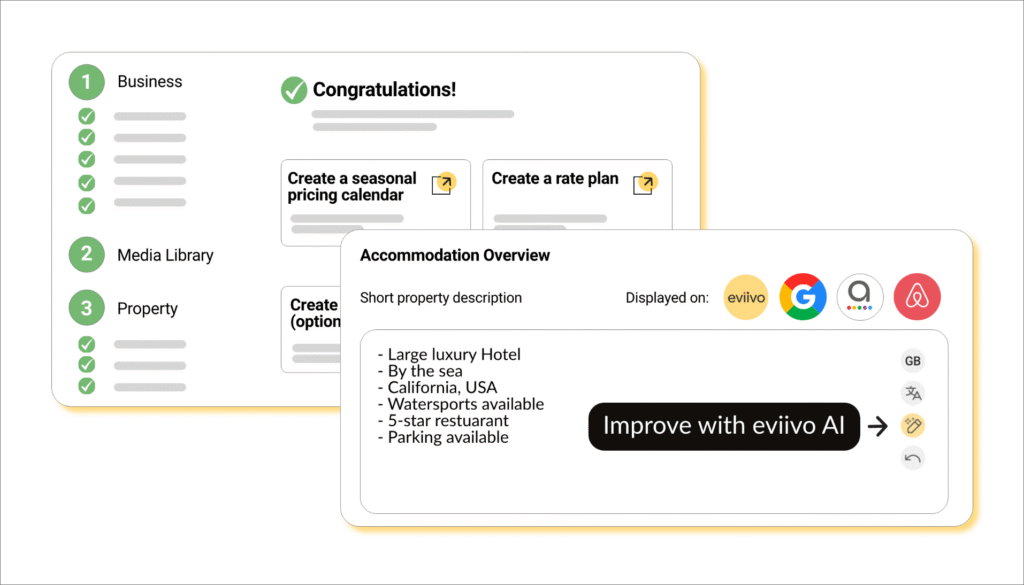
In today’s crowded travel market, visibility is vital. If you’re an independent accommodation provider, you probably already understand the value of being listed on popular online booking channels.
However, managing multiple channels manually can be hard work. Logging into different extranets and updating listings one-by-one isn’t just time-consuming, it’s a fast route to errors, inconsistencies, and dreaded overbookings.
A channel manager automates distribution to prevent those headaches, synchronizing your listings across all booking platforms. This means your rates, availability and inventory stay up to date across channels without manual intervention, saving you precious hours to focus on growth and your guests.
There’s a lot more to channel management than that, though. This guide will give you a thorough introduction to what channel manager software does, why it’s so beneficial, and how to choose the best option for your accommodation business.
What is a channel manager?
A channel manager is software that automatically synchronizes and updates your room availability, rates and inventory (ARI) across every online booking channel you use to sell your accommodation.
This automation enables you to spend less time making manual updates on individual extranets for Booking.com, Airbnb, Expedia, and all your other channels. Instead, you make a change once, from one platform, and it updates across channels instantly.
This means that guests always encounter accurate, up-to-date listings, no matter which channel they find you on. It also means that, if somebody books a room on one channel, you can be assured that the change in room availability is automatically reflected across all your other online booking channels.
By ensuring that availability, rates, bookings, and other content is always up to date, a channel manager saves you the hassle and risks of managing updates manually by channel. As a result, you’ll likely feel more confident distributing your accommodation across a diverse range of online channels, including online travel agencies (OTAs) such as Booking.com, Airbnb, Vrbo and Expedia; wholesalers and Global Distribution System (GDS) channels such as Sabre and Amadeus; and metasearch platforms such as Google Hotel Ads and Google Vacation Rentals.
What does a channel manager do?
The main function of a channel manager is to synchronize updates in real-time across multiple online booking channels – including OTAs, GDSs, metasearch platforms, and your direct booking engine.
This is achieved via a seamless, two-way flow of information. Let’s say you adjust a rate or close out a room. The channel manager pushes this update to all your connected channels instantly. Likewise, when a booking is made on any of your channels, the change in availability is automatically reflected everywhere else. This means there’s no risk that a room that’s reserved via one channel will remain available on another. Overbookings are essentially eliminated, as well as other inconsistencies or inaccuracies with your rates and inventory.
This real-time, two-way sync is achieved via XML (eXtensible Markup Language), which the channel manager uses to connect to the extranet of each channel. Most channel managers will use XML to synchronize updates of rates, availability and inventory (ARI).
However, more robust channel manager solutions can also synchronize two-way XML updates of other content, including policies, taxes, promos, photos, descriptions and guest messages. This saves you additional manual work by expanding the number of updates applied automatically across channels, leaving virtually no need to log into individual extranets.
Centralizing all your updates ensures you streamline the distribution process as much as possible. That’s why it’s important that your channel manager connects to your property management system (PMS) or central reservation system (CRS). By importing new reservations directly into your PMS and/or CRS calendar, your channel manager creates a single source of truth where bookings from all sources are displayed accurately and managed easily.
For the utmost convenience, you may opt for a PMS that comes with an integrated channel manager, such as eviivo Suite™. This level of integration ensures that your PMS, channel manager and booking engine act as one, supporting seamless synchronization without any need for fragmented third-party systems or complicated integrations.
What are the benefits of using a channel manager?
The main benefits of channel management software include:
- Reduced admin
- Cost savings
- Avoiding errors and overbookings
- More online bookings
- Centralized management
- Optimized distribution
- More direct bookings
- Expanded market reach
Streamline your admin and save costs
When rates, availability, photos, content, policies and more are instantly updated in real-time across the OTAs you choose to work with, you no longer require staff to manually update each distribution channel separately.
This will save your team countless hours in admin and leave them free to focus on the more important stuff, such as guest services, marketing, sales and strategy.
Those saved hours also correlate with money back in your pocket, as you potentially save the cost of paying someone to manage each distribution channel manually.
Avoid errors and overbookings
With a channel manager, all your rooms and availability are synced across your connected channels. Therefore, there is no space for human error or inadvertent overbookings.
This spares you the embarrassment and reputational damage of unsuspecting guests arriving to discover there’s “no room at the inn”. The real-time, two-way sync preserves one cornerstone of the guest experience by ensuring there’s no difference between what the guest has booked and what they get.
More visibility and online bookings
Using a channel manager is the most cost-effective form of global advertising available. Without the effort of manual extranet updates, you are more likely to feel confident expanding your channel mix. As a result, your accommodation is put in front of thousands of extra potential guests, and you only pay commission on confirmed bookings.
Major OTAs, such as Booking.com, Expedia Group and Airbnb, are typically the primary drivers of booking volume for independent accommodation providers. These big players act as traffic acquisition and conversion machines, spending millions on metasearch, paid social, SEO, and advertising campaigns. By working with them effectively, you can treat them as your outsourced marketing team and make them a powerful ally for boosting bookings.
Additionally, by keeping your OTA listings updated in real-time via a channel manager, you’re more likely to enjoy a better position in their search rankings, further boosting your booking volume.
Centralized management and granular control
With strong channel management software, there’s no need to learn the quirks of each channel’s extranet because you’re able to manage all updates in one place. As we have outlined previously, this greatly reduces admin and simplifies how you manage distribution.
However, flexibility is also important to distribution. Ideally, your channel manager should give you granular control of how you work with individual channels. For example, with a good channel manager, you can vary your prices and policies by OTA channel centrally to offset bad practices. So, if your bookings from one particular OTA are frequently cancelled last minute, you can vary your cancellation policies for that channel alone to give yourself a safety net.
Similarly, being able to configure promotions and charges by channel from one platform keeps you in full control of your connections.
Optimize distribution
A smart distribution strategy involves identifying the mix of sales channels you should use to reach your goals. Connecting to the right combination of OTAs, wholesalers, GDS platforms, niche channels and/or metasearch platforms helps ensure your accommodation can be found and booked by your target audience. Many channel managers also offer an iCal connection to regional community sites that charge low or no commission rates.
However, quality is more important than quantity. Rather than overdistributing to 400+ channels, it’s better to focus on the ones that will deliver the most value. For example, GDS channels are specifically suited to hotels in urban areas that offer business services and can accommodate the shorter stays preferred by corporate travelers.
If you want to identify your best-performing channel mix, the reporting capabilities integrated with your channel manager and/or PMS should allow you to monitor the performance of individual channels over time and adjust your strategy accordingly.
Your distribution strategy should also incorporate how you balance bookings between indirect and direct channels. Let’s explore the impact of channel management on direct bookings in more detail.
More direct bookings
Another benefit of using a hotel channel manager is ‘The Billboard Effect’, a phenomenon wherein properties advertising online through multiple indirect channels end up driving direct bookings through the increased exposure.
For example, let’s say a traveler finds your accommodation listed on a major OTA, but then decides to navigate from that listing to your direct website. If they subsequently choose to book directly, then that OTA has effectively brought you a booking without you having to pay their commission rate.
To trigger the billboard effect and convert OTA exposure into direct bookings, aim to offer searchers a smooth direct booking process that at least equals the OTAs for ease and convenience. Running web-exclusive deals or special direct-only terms can also help you nudge searchers towards booking on your website.
















What to look for in a channel manager
Today, the majority of channel managers synchronize ARI in real time across a range of booking platforms. Best-in-class channel management software options offer more advanced functionality that improve reliability, consistency, and integration. Here are some key criteria to consider.
1. Real-time ARI sync
Your channel manager should update availability, rates and restrictions in real time across all connected channels to prevent overbookings and discrepancies. By offering this reliability at scale, the software helps maintain accuracy during even the busiest demand periods and supports seamless rate parity, the practice of maintaining consistent rates across all distribution channels to build brand consistency and loyalty.
2. Depth of connectivity
ARI sync is the baseline of automated channel management. Look for a provider that goes deeper by synchronizing rich data, including ARI, policies, guest messages, restrictions and full content. This level of automation further reduces the need to update individual extranets while ensuring you deliver the consistency across channels that makes searchers more likely to convert.
3. Integration with core systems
Consider whether the channel manager is natively integrated with your other core tools, particularly your booking engine and PMS. Having all these tools in one system means they stay in sync and can be managed ‘all in one’, reducing manual work and improving accuracy. In contrast, standalone channel managers often rely on third-party integrations, creating greater complexity and operational risk.
Your PMS may also have the capabilities to handle OTA commission payments on your behalf and/or provide managed connections to specific channels., further streamlining distribution admin.
4. Multi-channel guest communications
Look for a channel manager that integrates with guest management tools to let your team centrally manage guest messages, reviews and booking inquiries across channels. By integrating multi-channel communications into one unified inbox, you improve response times, reduce dropped messages, and gain control of guest relationships, regardless of which channel they used to book.
5. User-friendliness and functionalities
You won’t achieve the full benefits of a channel manager if it’s hard to use and update. Look for software with a user-friendly interface that supports rapid onboarding and migration if you’re transferring existing listings. Evaluate whether the channel manager offers easy one-click connections to channels, AI tools to improve content, and advanced OTA merchandising options, such as detailed amenities management or opt-ins to channel-specific promotions.
6. Partnered channels
Ensure your provider connects to a range of booking channels, including major OTAs, metasearch platforms, GDSs, and local or niche channels. This will help you define your channel mix and reach the right guests from around the world. However, don’t opt for quantity over quality: for the best results, always prioritize the depth of your channel manager’s connections over a less reliable option that connects to hundreds of channels.
If you’re looking for a solution that’s specifically suited to hotel operations, read our hotel channel manager buyer’s guide.
The top channel managers for hospitality businesses
With the right technology, distribution should be a breeze. Below are a few options we’ve highlighted, suited to a range of different accommodation types and channel management requirements.
eviivo Suite
eviivo’s Channel Manager is a leading, award-winning option for independent hotels, vacation rentals and any other accommodation providers who want full distribution automation without complexity. Built into eviivo Suite™ and trusted by over 28,000 properties worldwide, it delivers real-time, two-way synchronization of availability, rates, inventory (ARI) and rich content – such as policies, taxes, promos, photos, descriptions and guest messaging – across major OTAs, GDSs and metasearch platforms, including Booking.com, Expedia, Amadeus, and Google. This depth of connectivity helps boost occupancy, prevents overbookings, and dramatically reduces manual work.
Unlike channel managers limited to ARI updates, eviivo distributes rich, AI-enhanced content and centralizes guest communications, payments and reconciliation in one platform. With fast onboarding, fixed monthly pricing and powerful controls by channel or in bulk, eviivo helps hospitality businesses go further, faster without compromise.
Cloudbeds
Cloudbeds Channel Manager supports simple ARI updates across more than 300 distribution channels as part of a broader all-in-one system.
SiteMinder
SiteMinder’s hotel channel management and distribution platform is commonly adopted as a standalone tool for hotels with an established PMS.
Lodgify
The Lodgify channel manager is specifically designed to help vacation rental owners and operators simplify distribution by integrating PMS and channel management tools.
UnoConnect by RateGain
UnoConnect is a distribution platform by RateGain that is particularly well suited to international hotel chains seeking global reach. It is partnered with 33 of the world’s top 40 hotel groups.
HostHub
HostHub provides a vacation rental channel manager that can synchronize listings between 200+ channels, offering a Zero Double Booking Guarantee on API-connected platforms.
STAAH
STAAH is a hotel channel management platform focused on connecting properties to more than 1,000 OTAs and distribution partners worldwide.
How much does a channel manager cost?
A channel manager can range in price based on varying factors, including property size, room volume, the provider’s pricing model, and whether any commissions are charged for connectivity. Because of the wide range of pricing variables at play – even within a single software – it’s often best to evaluate options based on the total cost of ownership rather than headline fees.
For example, some channel managers charge flat subscription fees, while others charge a percentage-based commission tied to booking value. Operational costs, such as staff time spent managing OTA extranets, reconciling payments, or correcting inconsistencies, should also be factored into the total cost of ownership.
Another important pricing consideration is whether the channel manager is natively integrated with your PMS and other core tools. This may deliver cost savings by reducing the need for separate software subscriptions and/or extra-cost add-ons.
eviivo’s Channel Manager is priced as part of a flat monthly subscription fee alongside eviivo Suite’s other core PMS, booking engine and mobile app tools. In addition, a flat $0.50 applies per confirmed booking. This flat pricing model ensures that pricing remains steady as accommodation businesses scale, delivering greater cost savings over time than percentage-based commissions, while eviivo’s native integration of multiple tools also helps keep costs predictable.
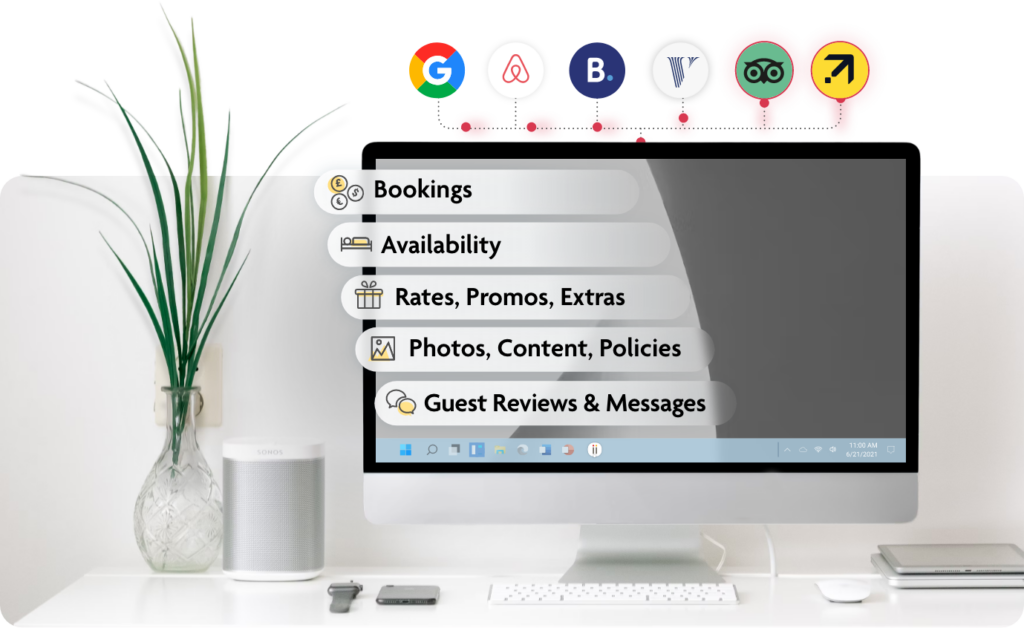
A channel manager is a foundational tool for staying visible, competitive, and in control of your distribution. By automating real-time updates across OTAs, GDSs, metasearch platforms and direct channels, the right channel manager puts an end to overbookings, reduces admin, and ensures guests always see accurate, compelling listings.
Ready to simplify distribution and grow bookings without the complexity? Book a demo of eviivo Suite today and see how far effortless connectivity can take you.
FAQs
A channel manager should integrate natively with your property management system (PMS), booking engine, payment processor, and major online travel agencies (OTAs). Deeper integrations also support two-way sync for content, policies, guest messages, promotions and more, which reduces reliance on OTA extranets and prevents data mismatches.
A channel manager prevents overbookings by instantly updating availability across all connected channels the moment a booking is made. This real-time, two-way XML synchronization ensures a room sold on one channel is immediately closed everywhere else.
A channel manager focuses on distribution, syncing rates, availability and inventory across booking channels. A PMS manages day-to-day operations like reservations, guest data, payments and reporting. The most reliable setups combine both in one platform, eliminating integration gaps and manual work.
If you list your accommodation on more than one booking site – or plan to – a channel manager quickly becomes essential. It allows independent operators to compete with larger brands by expanding visibility without increasing admin or risking overbookings.
Yes. Even single-property hotels or individual vacation rentals benefit from automated updates, consistent listings, and protection against double bookings, especially when demand spikes during peak seasons or local events.
Indirectly, yes. Wider OTA exposure creates the “Billboard Effect,” where guests discover your property on an OTA but book directly. Channel managers also keep your website availability accurate, and some options can support direct-only packages and promotions.
No. “Free” channel managers usually come with hidden costs, limited functionality, or commission-based pricing tied to booking value. A fixed monthly subscription is often more cost-effective and predictable as your booking volume grows.
 You might also be interested in…